Pages

Showing posts with label CNN. Show all posts

Tuesday, January 29, 2019

DDoC #06: How to capture the Global Context "Implicitly" using CNNs?

Sometime back, I had a look at "how the  global context is implicitly captured in recent holistic scene understanding methods?". Here's a small write-up about few things I observed.

image credits: https://quotefancy.com
CNNs are the most frequently/ recently used technique for  scene understanding.  The success of CNNs (applied for image classification) can be mostly attributed to the concepts of receptive field and locality.  CNN based models are inherently translation invariant due to locality. Both convolution and pooling operations are capable of progressively increasing the receptive field. This helps to derive abstract concepts from low level features for better generalization. However, still, arguments are going on about the practical effective receptive field being much smaller than the theoretical receptive field. Further, only looking at small region of input image result in the loss of global spatial contextual information. Yet, global context is quite useful for holistic scene understanding, so it is important to have a wider/ broad look at the input image.

How to increase the receptive field in CNNs? 

  • Adding multiple deeper layers 
  • Incorporate multi-scale scene context 
    • Inflating the size of the filter (a.k.a. dilated convolution)
    • Pooling at different scales (a.k.a. spatial pyramid pooling)

Semantic segmentation is the most widely used technique for holistic scene understanding. Fully Convolutional Networks (FCN) have adopted CNNs (that was initially used for image classification) for the task of semantic segmentation. Given an input image, semantic segmentation outputs a semantic segmentation mask that assigns a pre-determined semantic category to each pixel in the image. FCN achieves this by downsampling of image features followed by a rapid upsampling procedure to reconstruct the segmentation mask. However, this rapid upsampling procedure has lead to loss of contextual information. Recovering pixel level fine details from too coarse features (given as input for upsampling layer) is difficult.

How to upsample without loosing contextual information? 

  • Learn to upsample while remembering the lost context (Deconvolution operation with unpooling) (Pooling is [originally] used to filter out noisy activations)
  • Using the inherent/ built in semantic information flow at different scales in CNNs (Feature Pyramids)
I will mention the related papers soon. :)

Wednesday, January 16, 2019

DDoC #03: Seeing What Is Not There: Learning Context to Determine Where Objects Are Missing

My Daily Dose of Creativity (DDoC): Day 03 (No, not giving up yet :P)

Why?
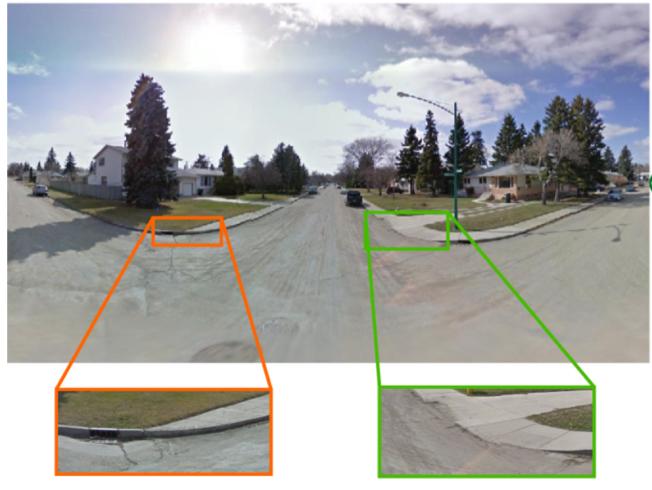
Most of the computer vision algorithms focus about what's seen in image. e.g., Is there a curb ramp in this image? If so, where it is? We need to infer what is not there in the scene too. e.g., where could be a curb ramp in this image? Can there be a curb ramp in this image?
Where could be a curb ramp in the second image (green)?


What?
Learn contextual features to predict the possibility of having an object in the scene, even if the object cannot be seen clearly

How?

  • Training: Learn contextual features (e.g., the surrounding characteristics) for a given object category (e.g., curb ramps) using a binary classifier (to predict whether there can be an object in the given image or not). Positive examples are taken by masking out the object bounding box in images. Negative examples are taken by masking out a similar, corresponding area as positive examples using random image crops (to prevent network from learning the masking dimension). If there are any other objects around positive example, they are also being considered as context and hence multiple objects in one image are not considered. This constitutes the base of the training algorithm. Then, in order to mitigate the artifact issues due to the said classifier, another classifier is used without bounding box masks. The idea is to just ignore the object and let the network to implicitly learn the context. During training, both classification loss and distance loss (difference between the first explicit context classifier and second implicit context classifier) are taken in to consideration.  
  • Inference: First the object bounding boxes are detected. Pixels inside the object bounding boxes are marked as 0 and pixels outside bounding boxes are marked as 1. Then, a heat map that represents the context is generated where pixels with high probabilities are marked as 1 and low probabilities are marked as 0. After that, pixel-wise AND operation is performed between the afore-mentioned two representations.  


More information can be found in their paper. 

image source: http://openaccess.thecvf.com/content_cvpr_2017/papers/Sun_Seeing_What_Is_CVPR_2017_paper.pdf

Monday, January 14, 2019

DDoC #01: Grad-CAM: Gradient based Class Activation Mapping

Daily dose of creativity (DDoC) is my attempt to learn something innovative/ creative on daily basis.  Today's paper is "Grad-CAM: Visual Explanations from Deep Networks via Gradient-based Localization".

Why?
Just having CNNs correctly classifying the given input images is not enough. We need an intuitive explanation on the reasons behinds the classification decision. Does CNN learn the right cues or does it learn some unrelated cue due to some biased information in the training data (e.g., unrelated background patterns)? Are they similar to how humans recognize objects in images?

What?
Grad-CAM for cat
We need to know which regions of an input image, CNN uses to classify a given image into a certain class. We also need to know what discriminative characteristics (e.g. patterns) in those images contributed mostly to classify the image (e.g., stripes in a tiger cat).

How?
Grad-CAM finds the importance of a given neuron when it comes to a particular class decision. For that, it computes the gradient of the class score with respect to the feature maps of convolution layer. The gradients flowing back are globally average pooled. They represent the importance of each activation map (weight) to a particular class label. Then Relu is applied on weighted (based on importance) combination of forward activation maps to derive the image regions with positive influence for a given class of interest. The importance of each region is projected as a heat map on the original image.

More information can be found in their paper.

Tuesday, July 3, 2018

Network Dissection to Divulge the Hidden Semantics of CNN

Needless to mention that nowadays deep convolutional neural networks (CNNs) have gained immense popularity due to its ability to classify or recognize scenes or objects with reasonable accuracy. However, we already know that CNNs can also be fooled by adversarial attacks, so that a given image, that was accurately recognized by a CNN earlier, can be altered in a way that even though its still possible for a human to recognize well, CNN would fail to do so [1]. So, the natural question arises "Are they genuinely learning about object or scenes like we humans do?"

Dissection
Researchers from MIT have recently conducted some experiments along that line as what's happening in hidden layers of CNNs still remains a mystery [2]. Their experiments aim to find out if those individual hidden units align with some human interpretable concepts such as parts of an object or objects in a scene. E.g., lamps (object detector unit) in place recognition, bicycle wheel (part detector) in object detection. If so, they need to find a way to quantify the emerged 'interpretability'. It's interesting to know that neurologists perform a similar task to uncover the behavior of biological neurons too.

Researchers have conducted experiments to find which factors (E.g., axis representation, training techniques) influences to interpretability of those hidden units too. They have found that interpretability is axis dependent, in the sense that if you change the rotation of a given image, the hidden units will no longer be interpretable. Further, different training techniques such as dropout or batch normalization have an impact on interpretability too.

You can find more details on this research here.

[1] https://kaushalya.github.io/DL-models-resistant-to-adversarial-attacks/
[2] D. Bau*, B. Zhou*, A. Khosla, A. Oliva, and A. Torralba. "Network Dissection: Quantifying Interpretability of Deep Visual Representations." Computer Vision and Pattern Recognition (CVPR), 2017. Oral.