Pages

Saturday, January 16, 2021

On intelligence: How a New Understanding of the Brain will Lead to the Creation of Truly Intelligent Machines by Jeff Hawkins

I can't believe I've written only a single blog post in 2020. 😲 2021 supposed to be the year that I read more books. Let's see ;) I hope what happened to my #dailydoseofcreativity in 2019 won't happen again with my new year 2021 goal 🙈. Daily is a too overwhelming commitment, so that's a bad idea.  Let's say bi-monthly to be on the safe side. Here's my first book, only read the first chapter and I'm already curious about his next book,  'Thousand Brains Theory of Intelligence', as well. 

Here are my favorite quotes so far. 💘

Many people today believe that AI is alive and well and just waiting for enough computing power to deliver on its many promises. When computers have sufficient memory and processing power, the thinking goes, AI programmers will be able to make intelligent machines. I disagree. AI suffers from a fundamental flaw in that it fails to adequately address what intelligence is or what it means to understand something. 

Turing machine: Its central dogma: the brain is just another kind of computer. It doesn't matter how you design an artificially intelligent system, it just has to produce human-like behavior. 

Behaviorism: The behaviorists believed that it was not possible to know what goes on inside the brain, which they called an impenetrable black box. But one could observe and measure an animal's environments and its behaviors - what it senses and what it does, its inputs and outputs. They conceded that the brain contained reflex mechanisms that could be used to condition an animal into adopting new behaviors through rewards and punishments. But other than this, one did not need to study the brain, especially messy subjective feelings such as hunger, fear, or "what it means to understand something".

Behavior is a manifestation of intelligence, but not a central characteristic of being intelligent. 

Wednesday, September 23, 2020

ECCV 2020: My Takeaways

ECCV 2020 was my first virtual conference experience. There was a very fancy virtual conference environment that looked somewhat realistic :)

source: https://eccv.6connex.eu/

A workshop that I attended even had a funny avatar just for myself using Gather Town. I was mindlessly running here and there among virtual booths just because it was so much fun 😂. This time I wanted to focus more on the domains that I'm not familiar with, so I chose sessions accordingly. Needless to say that having so many interesting sessions was quite overwhelming (in a good way), so I had to first browse through everything and prioritize which ones to attend. Both conferences and 'workshops & tutorials' sites were quite well-organized, so it wasn't difficult to do so. Honestly, I felt that the virtual conference is more effective and efficient in so many ways if we forget about the sightseeing aspect of live conferences ;). 

I mainly attended two workshops.

  • Computer vision for medical imaging: my research mainly focuses on human-like scene understanding. Digital camera sees the world somewhat similar to how a human would see. So, it was interesting to see machine perception from a different perspective, where we can see beyond the visible spectrum. There was a nice introductory session for newbies in medical imaging where they explained how to capture x-ray, ultra-sound, gamma, MRI and PET scans very comprehensively. 
    • How AI will transform health-care?: A (stroke) clinicians view
    • Challenges and pitfalls in medical image analysis 
  • Video Turing test: Toward Human-level Video Story Understanding: I attended two main sessions in this workshop. 
    • 10 questions for a theory of vision by Maro Gori: Using motion invariance [1] as a fundamental way to incorporate scale invariance, rotation invariance and deform invariance, etc. is quite innovative. Also, the ignorance of the "time" aspect for visual recognition (which I partly agree) was discussed. Of course, I clearly agree that the temporal dimension is important for scene understanding. However, as I feel humans can clearly recognize a single image, even an action or activity up to some extent without having multiple frames. 
    • Common sense intelligence by Yejin Choi: common sense reasoning is clearly a brave topic as it is hard to clearly define, yet very important aspect of realizing AI. If I say that this talk completely blew my mind, I'm not exaggerating. There she discussed the gap between perceptual level and cognition level visual understanding and inferring about the dynamic state change of the world. The related paper to this talk is [2]. So glad to see that this talk somewhat supports my view about still image recognition (..feeling relieved lol 👻).
Highlights from the regular sessions:

A unifying mutual information view of metric learning: cross-entropy vs. pairwise losses [3]: 
I attended this session because metric learning is my new-found love 😍 The core idea is deep metric learning can be approached both using pairwise losses and cross-entropy. In both cases, minimizing the contrastive loss is equivalent to maximizing the mutual information between features and labels. 

Grounded situation recognition [4] (AllenAI): 
This paper clearly mentioned the issue with image captioning when it comes to human-like model evaluation. I also felt that when a human see a scene he understands semantic concepts rather than grammatically correct sentences. In addition to the main situation recognition task, they have proposed a few additional tasks such as conditional localization and grounded semantic chaining. 

Women in computer vision 

Panel discussions and mentoring sessions were quite useful to keep us motivated during challenging times. I'm so grateful that role models in the computer vision field (both men and women) took some time and effort to share their experience with us. 
  • Push forward. You will find some way. 
  • If you want something, just ask for it. Be prepared for rejection. 
  • First, you should do some good work. Attention comes next. 
  • Quality over quantity (don't try to be a paper factory)
  • Don't go after low hanging fruits (e.g., incremental research). Do something different and new. 
  • History is important in any field. 
  • Having hobbies not only helps you to relax. They help your work also. 
  • Never give up :)
Industrial booths:
I got to know about Voxel 51 tool. If you are doing object detection related research, this tool might come in handy to deeply and easily analyze your detection results. Loved the "confidence slider" and "uniqueness" features [5]. 

Overall, it was such a great experience and kept me fascinated during the pandemic. It was like an "academic vacation" 💃. Kudos to the organizers who successfully organized a virtual conference for the first time. 

[1] Betti, A., Gori, M. and Melacci, S., 2020. Learning visual features under motion invariance. Neural Networks.

[2] Park JS, Bhagavatula C, Mottaghi R, Farhadi A, Choi Y. VisualCOMET: Reasoning about the Dynamic Context of a Still Image.

[3] https://www.ecva.net/papers/eccv_2020/papers_ECCV/papers/123510545.pdf 

[4] https://arxiv.org/abs/2003.12058 

[5] https://voxel51.com/docs/fiftyone/user_guide/brain.html

Tuesday, January 29, 2019

DDoC #06: How to capture the Global Context "Implicitly" using CNNs?

Sometime back, I had a look at "how the  global context is implicitly captured in recent holistic scene understanding methods?". Here's a small write-up about few things I observed.

image credits: https://quotefancy.com
CNNs are the most frequently/ recently used technique for  scene understanding.  The success of CNNs (applied for image classification) can be mostly attributed to the concepts of receptive field and locality.  CNN based models are inherently translation invariant due to locality. Both convolution and pooling operations are capable of progressively increasing the receptive field. This helps to derive abstract concepts from low level features for better generalization. However, still, arguments are going on about the practical effective receptive field being much smaller than the theoretical receptive field. Further, only looking at small region of input image result in the loss of global spatial contextual information. Yet, global context is quite useful for holistic scene understanding, so it is important to have a wider/ broad look at the input image.

How to increase the receptive field in CNNs? 

  • Adding multiple deeper layers 
  • Incorporate multi-scale scene context 
    • Inflating the size of the filter (a.k.a. dilated convolution)
    • Pooling at different scales (a.k.a. spatial pyramid pooling)

Semantic segmentation is the most widely used technique for holistic scene understanding. Fully Convolutional Networks (FCN) have adopted CNNs (that was initially used for image classification) for the task of semantic segmentation. Given an input image, semantic segmentation outputs a semantic segmentation mask that assigns a pre-determined semantic category to each pixel in the image. FCN achieves this by downsampling of image features followed by a rapid upsampling procedure to reconstruct the segmentation mask. However, this rapid upsampling procedure has lead to loss of contextual information. Recovering pixel level fine details from too coarse features (given as input for upsampling layer) is difficult.

How to upsample without loosing contextual information? 

  • Learn to upsample while remembering the lost context (Deconvolution operation with unpooling) (Pooling is [originally] used to filter out noisy activations)
  • Using the inherent/ built in semantic information flow at different scales in CNNs (Feature Pyramids)
I will mention the related papers soon. :)

Wednesday, January 23, 2019

DDoC #05: Visual memory: What do you know about what you saw?

A random read on "Gist of a Scene" this time, by Dr. Jeremy M. Wolfe.

When it comes to remembering a scene, humans do not go through all the details of the scene. What matters is only the gist of the scene. However, what constitutes the scene gist is not agreed upon yet. Some of the finding on that research direction are as follows:

1. Change in appearance does not cause a scene gist, (e.g., people remember a scene of a two women talking irrespective of the color of the cloths they wear. This is called “change blindness”
2. Scene gist is not just a collection of objects, relationships between the objects in the scene also matter (e.g., milk being poured from a carton into a glass is not the same as a picture of milk being poured from a carton into the space next to a glass)
3. Scene gist involves some information about the spatial layout of the scene
4. Scene gist also involves the presence of unidentified objects (people do not see all the objects, but they know that certain objects should be there even if it is not visible)

You can find more information in his article.

Thursday, January 17, 2019

DDoC #04: Connecting Look and Feel

Today's paper is "Connecting Look and Feel: Associating the Visual and Tactile Properties of Physical Materials". (Figure 1: with a self pat on my back for working on this, even when I'm little sick+in a bad mood. And then I found this cool image!)

Figure 1: self pat on my back source:
http://massagebywil.com/2011/10/25/pat-yourself-on-the-back/
Why?
Humans use visual cues to infer material properties of objects. Further, touch is an important way of perception for both robots and humans to effectively interact with the outside world. 

What?
Project the input from different modalities in to a shared embedding space to associate visual and tactile information.  

How? 
Fabrics are clustered to different groups using K-nearest neighbor algorithm based on their physical properties such as thickness, stiffness, stretchiness and density. For humans, these fabrics in similar cluster will have similar properties. 

Clusters of Fabrics with different properties 

Input:
Different modalities of input image of fabric (depth, color and tactile images from touch sensor) 
Output: Determine the whether the different modalities are from same fabric or different fabrics 

Process: 
First, a low dimension representation (different embedding) of these input data is extracted using CNN. Then the distance between these different embeddings is measured. The idea is to have smaller distance for different modalities of the same fabric and to have a larger distance for different modalities of the different fabric.  


So, the goal of optimization function is to minimize the distance between different modalities of same fabric using contrastive loss (In layman terms, neighbors are pulled together and non-neighbors are pulled apart)  

More information can be found in their paper. 

Wednesday, January 16, 2019

DDoC #03: Seeing What Is Not There: Learning Context to Determine Where Objects Are Missing

My Daily Dose of Creativity (DDoC): Day 03 (No, not giving up yet :P)

Why?
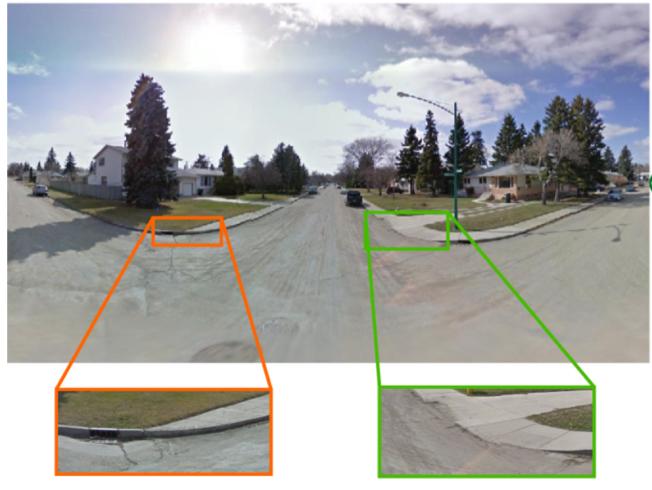
Most of the computer vision algorithms focus about what's seen in image. e.g., Is there a curb ramp in this image? If so, where it is? We need to infer what is not there in the scene too. e.g., where could be a curb ramp in this image? Can there be a curb ramp in this image?
Where could be a curb ramp in the second image (green)?


What?
Learn contextual features to predict the possibility of having an object in the scene, even if the object cannot be seen clearly

How?

  • Training: Learn contextual features (e.g., the surrounding characteristics) for a given object category (e.g., curb ramps) using a binary classifier (to predict whether there can be an object in the given image or not). Positive examples are taken by masking out the object bounding box in images. Negative examples are taken by masking out a similar, corresponding area as positive examples using random image crops (to prevent network from learning the masking dimension). If there are any other objects around positive example, they are also being considered as context and hence multiple objects in one image are not considered. This constitutes the base of the training algorithm. Then, in order to mitigate the artifact issues due to the said classifier, another classifier is used without bounding box masks. The idea is to just ignore the object and let the network to implicitly learn the context. During training, both classification loss and distance loss (difference between the first explicit context classifier and second implicit context classifier) are taken in to consideration.  
  • Inference: First the object bounding boxes are detected. Pixels inside the object bounding boxes are marked as 0 and pixels outside bounding boxes are marked as 1. Then, a heat map that represents the context is generated where pixels with high probabilities are marked as 1 and low probabilities are marked as 0. After that, pixel-wise AND operation is performed between the afore-mentioned two representations.  


More information can be found in their paper. 

image source: http://openaccess.thecvf.com/content_cvpr_2017/papers/Sun_Seeing_What_Is_CVPR_2017_paper.pdf

Tuesday, January 15, 2019

DDoC #02: Discovering Causal Signals in Images

Why?
Modern computer vision techniques are so good at modeling the correlation between the input image pixels and image features. However, if we can perceive the causal structure of a given scene, it helps us to reason better about the real-world.

What?
Discovering Causal Signals in Images (source: https://arxiv.org/abs/1605.08179)
Novel observational discovery technique called "Neural Causation Coefficient (NCC)" to predict the direction of a causal relationship between pair of random variables.  Use NCC to distinguish between object features and context features.

How?
  • Causal feature (X > Y): a real world entity (X) that causes the presence of an object (Y) e.g.,  car is there in the presence of a bridge (because, it does not make sense to have a floating car on top of river without a bridge) 
  • Anti-causal feature (X < Y): a real world entity (X) that are caused by the presence of an object (Y) e.g., a wheel is there in the presence of a car
  • Object feature: Feature that is mostly activated inside the boundary box of an object (e.g., car)
  • Context feature: Feature that is mostly activated outside the boundary box of an object (e.g., background) 
NCC is learnt using a synthetic dataset to predict the direction (< or >, e.g., causal or anti-causal) of a given image feature-semantic category (class) pair. Then, the extracted causal and anti-causal features are used to verify if they relate to object features and context features. During their experiments, they have found that object features are mostly related to anti-causal features. Also, they have observed that context feature can either relate to causal or anti-causal features (e.g., road [context]-car vs car-shadow [context]) 

Application: detect object locations in a robust manner regardless of their context 

More information an be found in their paper. 

Monday, January 14, 2019

DDoC #01: Grad-CAM: Gradient based Class Activation Mapping

Daily dose of creativity (DDoC) is my attempt to learn something innovative/ creative on daily basis.  Today's paper is "Grad-CAM: Visual Explanations from Deep Networks via Gradient-based Localization".

Why?
Just having CNNs correctly classifying the given input images is not enough. We need an intuitive explanation on the reasons behinds the classification decision. Does CNN learn the right cues or does it learn some unrelated cue due to some biased information in the training data (e.g., unrelated background patterns)? Are they similar to how humans recognize objects in images?

What?
Grad-CAM for cat
We need to know which regions of an input image, CNN uses to classify a given image into a certain class. We also need to know what discriminative characteristics (e.g. patterns) in those images contributed mostly to classify the image (e.g., stripes in a tiger cat).

How?
Grad-CAM finds the importance of a given neuron when it comes to a particular class decision. For that, it computes the gradient of the class score with respect to the feature maps of convolution layer. The gradients flowing back are globally average pooled. They represent the importance of each activation map (weight) to a particular class label. Then Relu is applied on weighted (based on importance) combination of forward activation maps to derive the image regions with positive influence for a given class of interest. The importance of each region is projected as a heat map on the original image.

More information can be found in their paper.

Sunday, October 28, 2018

On Creativity and Abstractions of Neural Networks

"Are GANs just a tool for human artists? Or are human artists at
the risk of becoming tools for GANs?"
Today we had a guest lecture titled "Creativity and Abstractions of Neural Networks" by David Ha (@HardMaru), Research Scientist at Google Brain, facilitated by Michal Fabinger.

Among all the interesting topics he discussed such as Sketch-RNN, Kanji-RNN and world models, what captivated me most is his ideas about abstraction, machine creativity and evolutional models. What exactly discussed on those topics (as I understood) is,


  • Generating images based on latent vectors in auto encoders is a useful way to understand how the network understands abstract representations about data. In world models [1], he has used RNN to predict the next latent vector which can think of as an abstract representation of the reality.
  • Creative machines learn and form new policies to survive or to perform better. This can be somewhat evolutionary (may be not during the life time of one agent). The agents can adopt to different scenarios by modifying them selves too (self-modifying agents).
Some other quotes or facts about human perception that (I think) has inspired his work. 

Sketch-RNN [2]:

"The function of vision is to update the internal model of the world inside our head, but what we put on a piece of paper is the internal model" ~ Harold Cohen (1928 -2016), Reflections of design and building AARON

World Models:

"The image of the world around us, which we carry in our head, is just a model. Nobody in their head imagines all the world, government or country. We have only selected concepts, and relationships between them, and we use those to represent the real system." ~ Jay Write Forrester (1918-2016), Father of system dynamics

[1] https://worldmodels.github.io/
[2] https://arxiv.org/abs/1704.03477

Wednesday, July 4, 2018

teamLab: Blurring the Boundaries between Art and Science

My Lizard Painting
Yesterday, we visited MORI building digital art museum: teamLab Borderless (This name is quite long and too hard to remember in the right order :P) which was opened recently in Odaiba... to make Odaiba, or Tokyo for that matter, even greater! 

Even though some exhibits look a bit trivial in the beginning, (I felt that the exhibition ticket was somewhat over priced, although it was at discounted price and regardless of the fact that we did not pay for it), a second thought after further reading made me feel so overwhelmed, impressed and fascinated about the extent of innovation, creativity and philosophical thoughts that they have put together in to each piece of art.

This museum gives us a great feel of how digital involvement can nicely complement the traditional forms of art and overcome their inherent limitations. The museum is based on few great concepts. One such concept that highly captivated my curious (... well, about perception, in its all forms) mind is their notion on ultra subjective space. Comparing that concept with the western perspective of paintings and ancient Japanese spatial recognition made the idea even more lucrative.

If you are planning to visit this museum, I highly recommend that  you understand those concepts before you visit the museum, in addition to other "things you should read before you visit", to make your museum experience even better.

On the other hand, some activities were quite fun too. Look at how I painted a cute lizard and the way it came alive a little later with all those "natural lizard like moves"!


Tuesday, July 3, 2018

Network Dissection to Divulge the Hidden Semantics of CNN

Needless to mention that nowadays deep convolutional neural networks (CNNs) have gained immense popularity due to its ability to classify or recognize scenes or objects with reasonable accuracy. However, we already know that CNNs can also be fooled by adversarial attacks, so that a given image, that was accurately recognized by a CNN earlier, can be altered in a way that even though its still possible for a human to recognize well, CNN would fail to do so [1]. So, the natural question arises "Are they genuinely learning about object or scenes like we humans do?"

Dissection
Researchers from MIT have recently conducted some experiments along that line as what's happening in hidden layers of CNNs still remains a mystery [2]. Their experiments aim to find out if those individual hidden units align with some human interpretable concepts such as parts of an object or objects in a scene. E.g., lamps (object detector unit) in place recognition, bicycle wheel (part detector) in object detection. If so, they need to find a way to quantify the emerged 'interpretability'. It's interesting to know that neurologists perform a similar task to uncover the behavior of biological neurons too.

Researchers have conducted experiments to find which factors (E.g., axis representation, training techniques) influences to interpretability of those hidden units too. They have found that interpretability is axis dependent, in the sense that if you change the rotation of a given image, the hidden units will no longer be interpretable. Further, different training techniques such as dropout or batch normalization have an impact on interpretability too.

You can find more details on this research here.

[1] https://kaushalya.github.io/DL-models-resistant-to-adversarial-attacks/
[2] D. Bau*, B. Zhou*, A. Khosla, A. Oliva, and A. Torralba. "Network Dissection: Quantifying Interpretability of Deep Visual Representations." Computer Vision and Pattern Recognition (CVPR), 2017. Oral.

Sunday, July 1, 2018

Taskonomy: Disentangling Task Transfer Learning


image source: Taskonomy [1]
The common computer vision tasks such as  depth estimation, edge detection are usually performed in isolation.

While scanning through this year’s CVPR papers, I noticed this interesting research [1] (CVPR Best Paper award winner!) that introduced a term called “Taskonomy” (Task + Taxonomy).

Taskonomy focuses on deriving the relationships between these common computer vision tasks so that it can find some representations obtained by certain computer vision tasks that can be useful (in terms of efficient computation time and/ or requirement for less labeled data) in other computer vision tasks.

This is also known as ‘task transferability’.  Some interesting visualizations and more information on this research can be found here.

[1] http://taskonomy.stanford.edu/

Seeing is 'Not Necessarily' Believing?

Recently, I read the Nature article, “Our useful inability to see the reality”that introduced a book called “Deviate: The Science of Seeing Differently”. I haven’t read the book yet, but this seems to shed some light on the idea of perception. The basic idea seems to be that we see what we want to see, based on our past experience, and not necessarily what’s out there in reality. In other words, the information we acquire from our eyes has much less to do with how we derive the actual meaning of it (in relation to ourselves of course). Specifically, it is being discovered that the 90% of the neurons that are responsible to make sense of what we see don’t consist of the visual fields in the brain.

Saturday, June 30, 2018

Favorite quotes from "Lab Girl" by Hope Jahren

"While looking at the graph, I thought about how I now knew something for certain that only an hour ago had been an absolutely unknown, and I slowly began to appreciate how my life had just changed. I was the only person in an infinite exploding universe who knew that the powder was made of opal. In a wide, wide world, full of unimaginable numbers of people, I was - in addition to being small and insufficient - special. I was not only a quirky bundle of genes, but I was also unique existentially, because of the tiny detail that I knew about Creation, because of what I had seen and then understood. Until I phoned someone, the concrete knowledge that opal was the mineral that fortified each seed on each hackberry tree was mine alone. Whether or not this was something worth knowing seemed another problem for another day. I stood and absorbed this revelation as my life turned a page, and my first scientific discovery shone, as even the cheapest plastic toy does when it is new."

"I had worked and waited for this day. In solving this mystery I had also proved something, at least to myself, and I finally knew what real research would feel like."

"Afterward I reward myself by sitting in my office choosing and ordering chemicals and equipment, feeling like a giddy bride picking out her gift registry"

"As research scientists, we will never ever be secure."

"He knows about the many nextstory.doc files in my hard drive; He knows how I like to sift through the thesaurus for hours; he knows that nothing feels better to me than finding the exactly right word that stabs cleanly at the heart of what you are trying to say."

Thursday, June 28, 2018

Look Closer to See Better

image source: wikipedia
Hearing about this recent research made me feel a little dumb, and hopefully you will feel the same too. But, anyways it's quite impressive to see the advanced tasks that machines are getting capable of. What we usually hear is that even though recognizing a cat is a simple task for humans, it is quite challenging task for a machine, or let's say.. for a computer.

Then, try to recognize what's in this image? If I was given this task, I would have just said that it's a 'bird', hopefully you would too, unless you are a bird expert or enthusiast. Of course it's a bird, but what if your computer is smart enough to say that it's  a 'Laysan albatross' 😂Not feeling dumb enough yet? Seems like the computer is aware of which features in which areas of its body make it a 'Laysan albatross' too.

Even though, there exists some promising research on region detection and fine grained feature learning (E.g., find which region of this bird contain more discriminative features from other bird species and then learn those features, so that we can recognize the bird species of a new, previously unseen, image), they still have some limitations.

So this research [1] focuses on a method where the two components namely attention based region detection and fine grained feature learning strengthen or reinforce each other by giving them feedback to perform better as a whole. The first component starts by looking at the coarse grained features of a given image to identify which areas to pay more attention to. Then the second component will further analyze the fine grained details of those areas to learn what features make this area unique to this species. If the second component is struggling to make confident decisions on recognizing the bird species, then it will inform that to first model as the selected region might not be very accurate. 

More information about this research can be found here.

[1] J. Fu, H. Zheng and T. Mei, "Look Closer to See Better: Recurrent Attention Convolutional Neural Network for Fine-Grained Image Recognition," 2017 IEEE Conference on Computer Vision and Pattern Recognition (CVPR), Honolulu, HI, 2017, pp. 4476-4484.


Sunday, June 24, 2018

What makes Paris look like Paris?

windows with railings in Paris
Cities have their own character. May be that’s what makes some cities notable than the others. In her award winning memoire “Eat, Pray, Love”, Elizebeth Gilbert mentions that there’s a ‘word' for each city.  She assigns ‘Sex' for Rome, ‘Achieve' for NewYork, ‘Conform' for Stockholm (To add more cities that I have been to, how about ‘ Tranquility' for Kyoto, ‘Elegance' for Ginza and ‘Vibrant' for Shibuya?). When terrorists attacked Paris in 2015, more than 7 million people shared their support for Paris under the #PrayforParis hash tag within 10 hours. Have you ever thought what characteristics make a city feels the way it is? Can we make a machine that can ‘feel' the same way about cities as the humans do? 

May be we are not there yet. Nevertheless, researchers from Carnegie Mellon University and Inria have taken an innovative baby step towards this research direction by asking the question “What makes Paris look like Paris?” [1]. Is it the Eiffel tower what makes Paris looks like Paris? How can we find if a given image is taken in Paris if the Eiffel tower is not present in that image? 


To start with, they asked people who have been to Paris before, to recognize Paris from some other cities like London or Prague. Humans could achieve this task with significant level of accuracy. In order to make a machine that can perceive a city as the same way as a human does, first we need to figure out, "What characteristics of Paris help humans to perceive Paris as Paris?".  So, their research focuses on automatically mining the frequently occurring patterns or characteristics (features) that make Paris geographically discriminative than the other cities. Even though, there can be both local and global features, the researchers have focused only on local, high dimensional features. Hence, image patches at different resolutions, represented as HOG+color descriptors are used for the experiments. Image patches are labeled as two sets namely Paris and non-Paris (London, Prague etc.) Initially, the non discriminative patches, things that can occur in any city such as cars or sidewalks, are eliminated using nearest neighborhood algorithm. If an image patch is similar to other image patches in ‘both' Paris set and non-Paris set, then that image patch is considered as not discriminative and vice versa. 
Paris Window painting
by Janis McElmurry

However, the notion of “similarity” can be purely subjective when it comes to similarity between different aspects. So, the standard similarity measurements used in the nearest neighborhood algorithm might not represent the similarity between the elements from different cities well. Accordingly, researchers have come up with a distance or similarity metric that can be learned or adopted to find discriminative features using the available image patches in an iterative manner. This algorithm is executed with images from different cities such as Paris and Barcelona to find distinctive stylist elements of each city.

Interesting fact about this research (well, at least for myself) is artists can use these research findings as useful cues to better capture the style of a given place. More details about this research can be found here.

[1] Carl Doersch, Saurabh Singh, Abhinav Gupta, Josef Sivic, and Alexei A. Efros. What Makes Paris Look like Paris? ACM Transactions on Graphics (SIGGRAPH 2012), August 2012, vol. 31, No. 3.

Tuesday, June 19, 2018

Panoptic Segmentation


Panoptic segmentation is a topic that was discussed during our lab seminar recently, because it could potentially improve scene understanding in autonomous vehicles using vision sensors. 

Successful approaches based on convolutional nets have been proposed previously for semantic segmentation task. Further, methods based on object or region proposals have become popular to detect individual objects as well. 

Image source: [1]
The idea behind panoptic segmentation [1] is unifying the tasks of semantic segmentation (studying about 'stuff' such as sky, grass, regions) and instance segmentation using object detectors (studying about countable 'things', E.g., different instances of cars). 

'Panoptic quality (PQ)' metric is proposed as a novel method to evaluate the proposed approach. More details about this can be found here and a simpler version here.  

[1] Panoptic Segmentation, Alexander Kirillov, Kaiming He, Ross Girshick, Carsten Rother, Piotr Dollar

Monday, June 18, 2018

Theoretical Understanding of Deep Learning using Information Theory


Information theory in communication
Information theory has been proved useful in many applications such as digital communication, computer networking and multimedia compression. For example, the concept of entropy (average information content) can be used to determine the minimum length a given message can be encoded before transmission and the concept of mutual information can be used to determine the channel capacity of a given communication channel. 
Information bottleneck
(analogous to optimal representations)

Regardless of the recent breakthroughs of deep learning, 'why they work, the way they work?', still remains a mystery. Recently, I read about an interesting attempt [1] where the researchers tried to understand the inner workings of deep learning algorithms using the notion of information theory. There, they have come up with a concept called "information bottleneck" to describe the most relevant features or signals with sufficient discriminative ability, excluding all the noise, to solve a given problem. In other words, the goal of the deep neural network is to maximize the information bottleneck (compressing the network as much as possible while preserving the prediction accuracy).

More information can be found here (their original paper) and here (a much simplified version!).

[1] Opening the Black Box of Deep Neural Networks via Information, Schwartz-Viz & Tishby, ICRI-CI 2017

Image sources:
[1] http://www.nairaland.com/3943054/information-theory-made-really-simple
[2] https://www.techwell.com/techwell-insights/2017/05/finding-bottlenecks-agile-and-devops-delivery-cycle

Thursday, December 21, 2017

Suffix trees: Algorithm of 1973

Interesting read on suffix trees

Kolmogorov Complexity and Algorithmic Information Theory

Measuring complexity of an algorithm by using length of the shortest possible description (series of instructions)
Turing machine/ Universal Turing machine - programs form a prefix free set (Kologorov complexity/ analogous to information theory) [1]
Church Turing thesis

[1] Elements of Information Theory